
- This topic is empty.
-
AuthorPosts
-
2026-10-20 at 5:57 pm #9811
Outdoor tennis courts create a practical challenge for sports clubs, schools, residential communities, and facility operators: how can a court remain well-lit for evening play without disturbing nearby homes?
The problem is not always that the lights are too bright. Poorly directed floodlights, unsuitable beam angles, excessive light output, and inappropriate fixture positioning can allow light to spill beyond the court. Nearby residents may experience unwanted brightness through windows, while facility operators may face complaints or restrictions on evening operating hours.
Effective outdoor tennis court lighting design should therefore balance player visibility, playing-surface illumination, environmental impact, and the needs of the surrounding community.
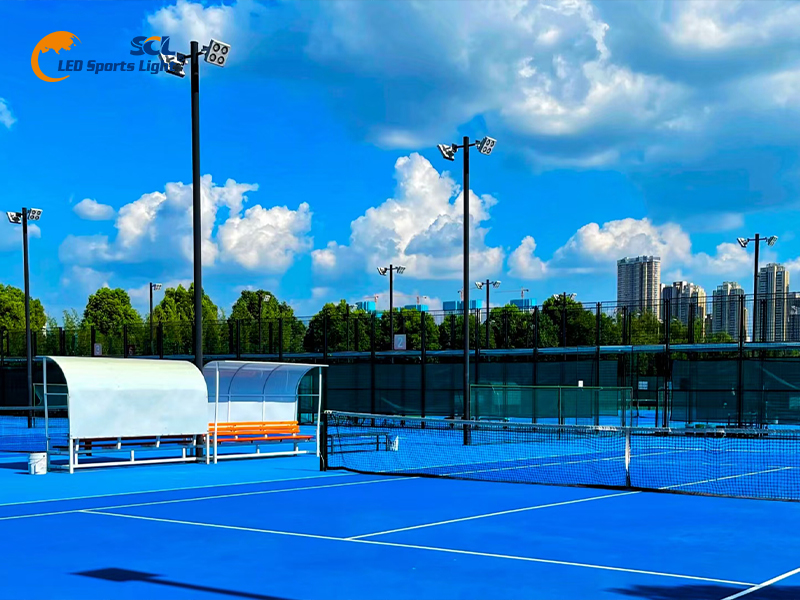
1. What Causes Light Spill from Outdoor Tennis Courts?
Light spill occurs when artificial light reaches areas beyond its intended target. For tennis facilities, this may include neighboring properties, residential windows, roads, gardens, and other sensitive locations.
Several factors can give rise to this issue.
Poor fixture aiming
Floodlights aimed too high or at unsuitable angles can direct light beyond the playing area. Even fixtures with appropriate optical designs may create unwanted spill if their aiming positions are not carefully planned.
Unsuitable beam distribution
A floodlight’s beam distribution determines how light spreads across the court. If the beam is too broad for the installation geometry, some light may reach surrounding areas instead of the playing surface.
The goal is not simply to choose the narrowest beam. Designers need to distribute sufficient light across the entire court while limiting unnecessary illumination outside it.
Incorrect mounting height and pole placement
Pole height and location influence the angles at which fixtures illuminate the court and the surrounding environment. Low mounting heights may require steeper aiming angles, while poorly positioned poles can create uneven coverage and increase the difficulty of controlling spill.
Excessive lighting output
Installing more light than the facility needs can increase unwanted illumination. Recreational courts, school facilities, private clubs, and competition venues may have different lighting requirements, so the design should begin with the intended use rather than a fixed assumption about brightness.
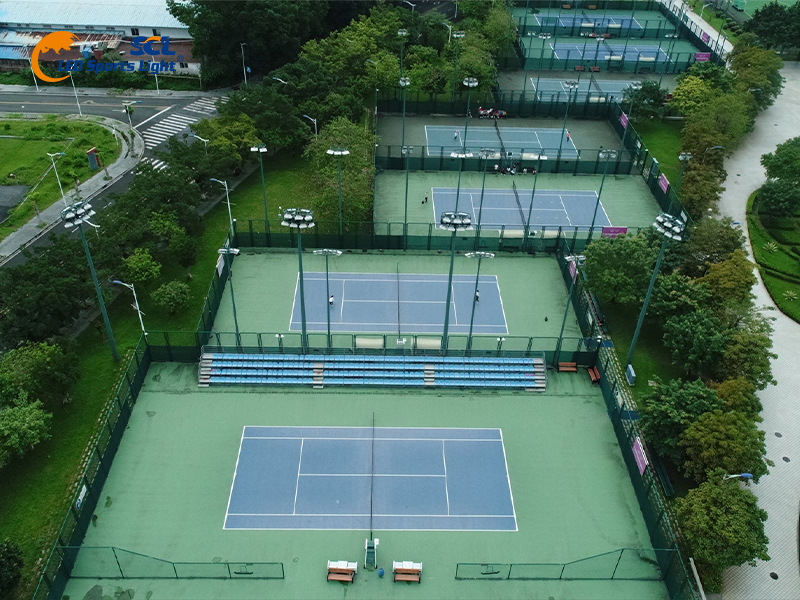
2. How Can Tennis Court Lighting Reduce Light Spill?
The most effective solution is usually a combination of optical design, careful layout planning, appropriate lighting levels, and operational controls.
Select fixtures with suitable optics
LED sports floodlights should be selected according to the court dimensions, mounting geometry, required illumination, and surrounding environment.
Suitable optics can help direct light toward the playing surface and reduce unnecessary light beyond the court boundaries. Where residential properties are nearby, the designer should pay particular attention to the sides of the court facing those properties.
Fixture selection should be based on photometric data rather than wattage alone. Two fixtures with the same electrical power can distribute their light very differently.
Aim the floodlights precisely
Floodlight aiming should be established through a coordinated lighting design rather than adjusted independently during installation.
Designers should assess the intended beam direction, aiming angle, and coverage of each fixture. They should also consider where residents are likely to see the luminaires directly, especially from upper-floor windows.
A well-planned arrangement can help maintain court visibility without unnecessarily directing light toward neighboring properties.
Plan the pole layout around the site
The ideal pole arrangement depends on the court’s dimensions, available installation space, nearby buildings, trees, fences, and other obstructions.
Where possible, pole positions should be selected early in the design process. Moving poles or changing fixture orientations late in a project can affect both court uniformity and spill-light performance.
For existing courts, designers should assess whether current poles can be reused or whether revised positions and mounting heights are needed.
Use appropriate lighting levels
Higher illuminance is not automatically better. The required lighting level depends on the type of tennis facility, level of play, and applicable standards or project specifications.
Overlighting can increase energy consumption and make light spill more difficult to control. A suitable design should meet the court’s actual requirements without delivering unnecessary illumination.
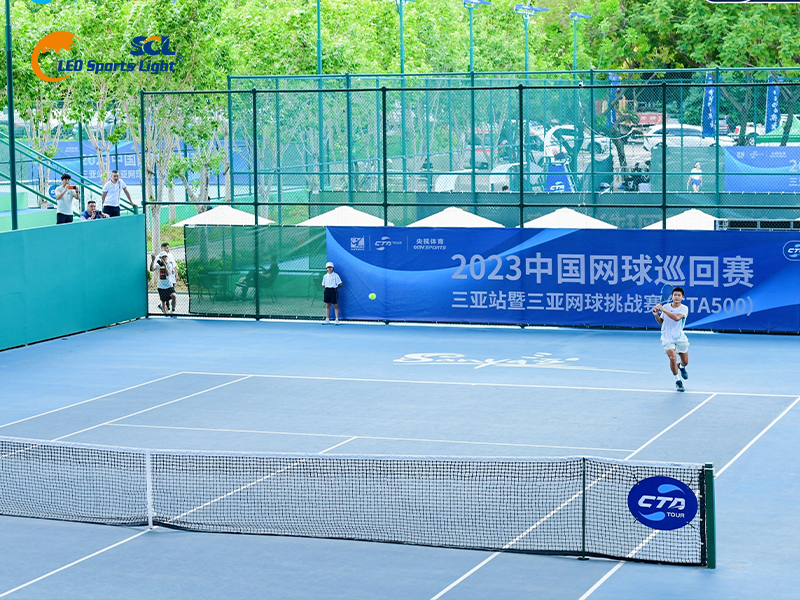
3. Why Is Uniformity Important When Controlling Light Spill?
Mitigating light spill is not as simple as dimming all floodlights. If the lighting system is poorly designed, lowering the output may reduce unwanted light but also leave dark areas on the court.
Tennis players need to track a small, fast-moving ball across different parts of the playing area. Significant variations in brightness can affect visibility during rallies, serves, and overhead shots.
A good outdoor tennis court lighting design must therefore balance three objectives:
l Adequate illuminance: The playing surface receives the light required for its intended use.
l Consistent distribution: Bright and dark areas are controlled across the court.
l Limited unwanted light: Light reaching neighboring properties and other sensitive areas is minimized.
These objectives should be evaluated together. A design that reduces spill but creates poor court uniformity may not provide a satisfactory playing environment.
4. Can Lighting Simulation Predict Light Spill Before Installation?
Yes. Photometric simulation is an important planning tool for evaluating outdoor tennis court lighting before fixtures are installed.
Using the proposed fixture photometric files, court dimensions, pole positions, mounting heights, and aiming angles, designers can estimate how light will be distributed across the court and surrounding areas.
For projects near residential properties, the assessment should consider more than the playing surface. Depending on the site and applicable requirements, designers may also examine illumination at nearby property boundaries, windows, and other sensitive locations.
A useful simulation should help answer questions such as:
l Does the proposed layout meet the court’s illuminance requirements?
l Is light distributed consistently across the playing area?
l Which fixtures may contribute most to spill toward neighboring buildings?
l Could a different optical distribution or aiming angle improve the design?
l Can the required lighting performance be achieved with less unnecessary output?
Simulation results are estimates, not a guarantee of actual performance. Final results depend on installation accuracy, aiming, surrounding conditions, and the quality of the input data. On-site checks may be needed to confirm performance after installation.
5. How Can Lighting Controls Help Reduce Disturbance?
Lighting controls can help operators manage outdoor courts more efficiently, particularly when the facility serves different users throughout the day.
For example, a tennis club may need full lighting during scheduled evening matches but a different operating arrangement for routine practice or court cleaning.
Depending on the installed system, useful functions may include:
l Dimming: Adjusting light output to suit permitted operating modes and applicable lighting requirements.
l Scheduled switching: Turning lights off when courts are no longer in use.
l Zoned control: Operating selected courts independently instead of illuminating an entire complex unnecessarily.
l Preset lighting scenes: Switching between predefined modes where the system supports this functionality.
Controls should complement, not replace, sound optical design. Dimming an incorrectly aimed floodlight may reduce spill, but it does not correct the underlying distribution problem. The facility should also ensure that every operating mode maintains appropriate visibility and complies with applicable requirements.
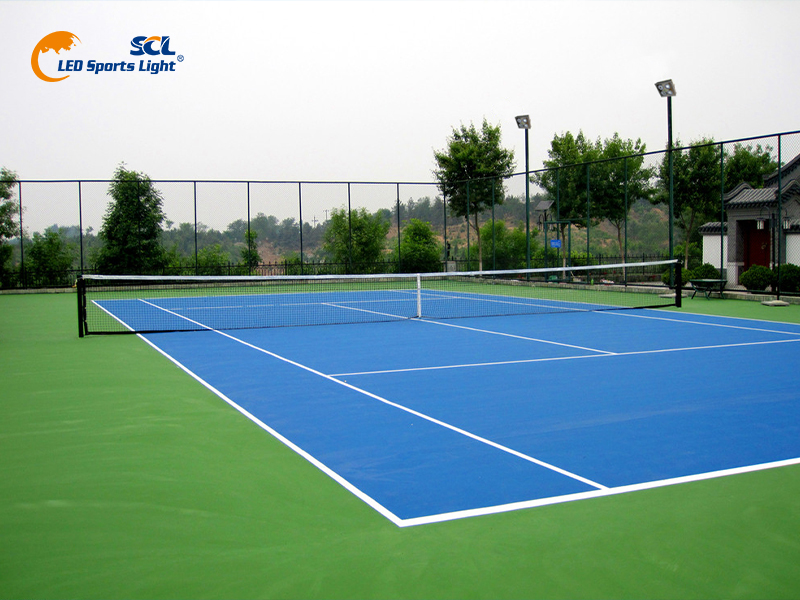
6. What Should Facility Owners Check Before Upgrading Existing Court Lighting?
For tennis clubs and schools dealing with complaints about nighttime lighting, a complete replacement may not always be the first step. The existing layout should be assessed to identify the main cause of the problem.
Before choosing a solution, review the following points:
1. Inspect fixture aiming. Check whether the existing floodlights are directed appropriately toward the playing surface.
2. Review the lighting layout. Confirm pole positions, mounting heights, court dimensions, and surrounding buildings.
3. Evaluate photometric performance. Check both court illuminance and uniformity, together with relevant spill-light considerations.
4. Assess fixture suitability. Determine whether existing optics can meet the requirements or whether alternative LED sports floodlights are needed.
5. Review operating schedules. Identify whether zoning, timers, or dimming could reduce unnecessary nighttime lighting.
6. Verify the completed work. After adjustments or replacement, check that the playing area remains adequately lit and that the intended reduction in spill has been achieved.
This approach helps operators distinguish between a fixture-selection problem, a layout problem, an aiming problem, and an operational problem.
7. How Does Professional Sports Lighting Design Address Different Tennis Facilities?
The same lighting solution will not suit every tennis court. A private residential court, a university tennis center, a commercial club, and a venue hosting international competition have different requirements.
For example, a residential court may place particular emphasis on spill-light control and quiet nighttime operation. A university facility may need to accommodate regular training and organized competition, while a major tournament venue may have additional requirements for uniformity, spectator visibility, and television broadcasting.
SCL Sports Lighting has supplied lighting systems for tennis facilities including Guangdong Olympic Tennis Center, Sichuan International Tennis Center, and Sanya International Tennis Center.
These projects provide relevant examples of sports lighting applications across different tennis venues. The appropriate design for any new project should still be based on its own court layout, operating needs, applicable performance requirements, and surrounding environment.
For facilities close to residential areas, these same design principles—appropriate optical distribution, coordinated aiming, uniformity assessment, and site-specific planning—are important considerations when developing a suitable lighting solution.
Conclusion
Reducing light spill from outdoor tennis courts requires more than installing lower-wattage fixtures or dimming existing lights. The underlying lighting design must direct light where it is needed while maintaining suitable visibility and uniformity across the playing surface.
For courts near homes, the most effective strategy combines appropriate LED sports floodlight optics, carefully planned pole positions, precise aiming, photometric simulation, and sensible lighting controls.
By addressing these factors before installation—or during a carefully assessed upgrade—facility operators can work toward a better balance between nighttime tennis, visual comfort, energy use, and consideration for neighboring residents.
https://www.stadiumlight.com/
GUANGDONG SEVEN CONTINENTS INDUSTRIAL CO., LTD -
AuthorPosts

- You must be logged in to reply to this topic.


