
- This topic is empty.
-
AuthorPosts
-
2026-10-22 at 4:41 pm #9821
Data center operators evaluating UPS battery suppliers tend to weigh the same set of variables: energy density, discharge rate, footprint, safety architecture, lifecycle cost, certification coverage, and the supplier’s ability to deliver on schedule in multiple regions. Vision Battery, the brand of Shenzhen Center Power Tech Co., Ltd. (stock code 002733), has supplied backup power since its founding in 1994 and today positions itself as a global provider of smart energy solutions focused on safe, efficient, and low-carbon power supply and distribution systems for data centers, computing centers, communication facilities, and edge computing nodes.
What Data Center UPS Batteries Must Deliver Today
The industry pain point is well documented: AI data centers and other critical infrastructure face rising requirements for high power density, mission-critical reliability, lower PUE, TCO reduction, fast deployment, ESG compliance, and the need to align backup power with next-generation high-voltage DC architecture. Those pressures shape the entire selection process, and they explain why a supplier’s product roadmap matters as much as its current catalog.
How Vision Battery Is Structured to Serve That Demand
Thirty Years of Backup Power Focus
Founded in 1994 and headquartered in Shenzhen, China, the company employs more than 3,000 people and operates five global R&D and manufacturing bases, with branch offices across Mainland China, Hong Kong, Vietnam, Singapore, India, France, Germany, and the United States. It holds 1,000+ patents, supports 12 GWh+ annual production capacity, and has delivered more than 800 professional energy solutions across over 100 countries and regions.
For cross-border projects, the company’s international industrial layout with overseas dual-base production capacity supports local delivery, compliance certification, and nearby service — a practical advantage when a data center campus must be commissioned to a fixed schedule. Its self-developed R&D and production spans lithium batteries, lead-acid batteries, hydrogen fuel cells, and sodium-ion batteries.
Ecosystem and Technical Partner Alignment
Deep partnerships with Vertiv, Schneider Electric, Eaton, Socomec, and Delta simplify selection, matching, and project admission. The company also contributes to standards work, including a national standard for computing center energy storage systems (in public comment stage), a group standard for virtual power plant operation (published and implemented), an electrochemical energy storage power station fire safety standard, and the group standard Safety Acceptance Regulations for Electrochemical Energy Storage Power Stations (published and implemented).
The Product Matrix in Practice
Lithium UPS Systems: REVO SP and REVO TP
The REVO SP Series covers single-phase UPS scenarios with models SP12, SP36, SP48, SP51.2, SP72, and SP192, spanning 12V to 192V single-phase UPS DC buses, and is designed as more than a direct lead-acid replacement.
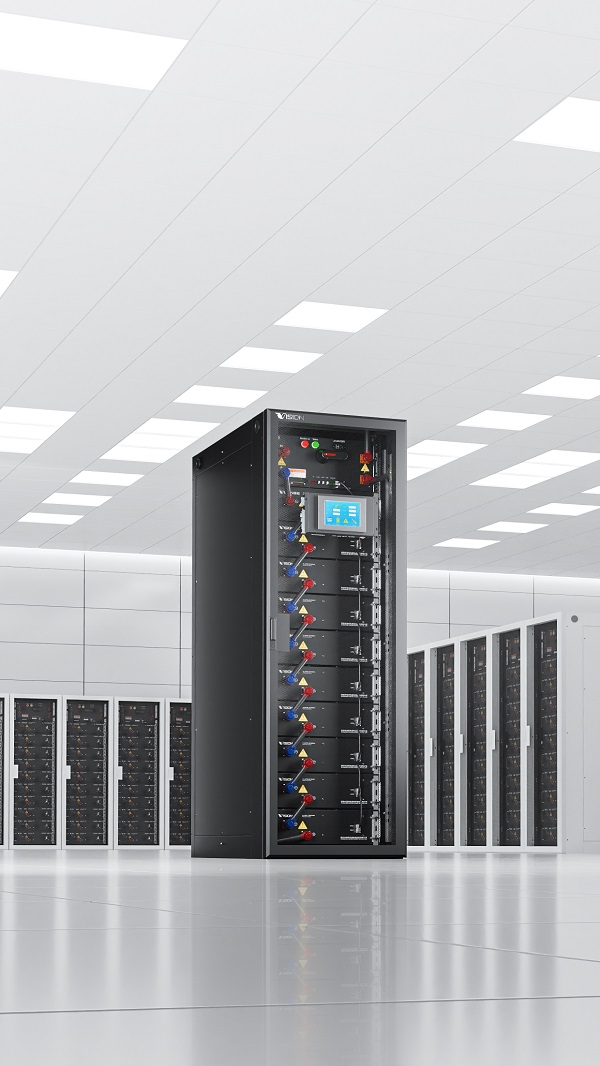
The REVO TP Series targets three-phase UPS in AI data centers and critical facilities. The TPX600 single cabinet supports up to 600 kW, meaning a 1.2 MW UPS requires only 2 cabinets and can save about 90% floor space versus conventional solutions. Discharge capability reaches 10C continuous and 30C pulse, addressing AI load transient fluctuation. The full range — TPX, TP, TPH, and TPL — covers 40 kW to 600 kW without gaps. Active balancing and liquid cooling reduce cell inconsistency, a 10-layer safety design protects from cell and module level through electrical isolation to fire suppression, and communication support includes Modbus TCP, Modbus, and Redfish for UPS, DCIM, and EMS coordination.
Lead-Acid Systems: HFS and 2V Large High-Power
The HFS High-Power Lead-Acid System is built for short-time, high-power discharge of 5–15 minutes. Standard models run from HFS12-115W-X to HFS12-850WR-X; front-terminal models from HFS12-380WF-X to HFS12-700WF-X enable compact in-cabinet installation. A high-power paste and high-tin low-calcium alloy improve grid corrosion resistance. The 2V Large High-Power Lead-Acid System covers UPS2000, UPS2800, and UPS4000 for large UPS backup with direct replacement and expansion in traditional DC systems.
Prefabricated and Energy Storage Systems
The PTU Lithium Prefabricated Cabin spans 1.8 MW to 3.5 MW with factory-integrated fire suppression, thermal control, and BMS. The BESS Immersion Liquid-Cooled Energy Storage Integrated Unit offers 241 kWh with cells fully immersed in insulating coolant, isolating oxygen and reducing thermal runaway probability. The CBES Large Liquid-Cooled Energy Storage Battery Cabin delivers 5 MWh or 6.48 MWh per cabin with IP55 outdoor deployment and multi-mode operation covering backup, peak shaving, and dynamic capacity expansion.
800V HVDC and Rack-Level Backup
On the 800V HVDC Storage-Backup Integrated System, storage connects directly to an 800V DC load end with system efficiency of 92% or higher, using semi-immersion liquid cooling and full outdoor IP55 deployment. The system without energy storage uses a native 800V DC architecture with 16/18/20/22/24 module configurations and hot-swappable redundancy. At rack level, the BBU Short-Time Backup Unit covers BBU-72kW, BBU-102kW, and a 1.2MW Sidecar across 48/54V to 800V DC, while the LiLic Sidecar Ultra-Fast Response Backup System provides 1MW 800V response placed close to AI racks.
Deployment Evidence Across Regions
Field data illustrates scale. The Malaysia BDC Project used 448 REVO TP200 units for 112 MW, commissioned in 2023. The EPLDT Project in the Philippines delivered 439 battery racks at 109.75 MW in 2023. GDS HK1, HK2, and HK3 reached 96 MW across 384 battery racks, commissioned in 2024. The Mercury Project delivered 520 battery racks for 130 MW in 2024. SoftBank Sakai Data Center in Japan is scheduled for 2026 with 436 racks at 8-minute BOL, and Keppel Gera in Singapore is scheduled for 2027 with 64 racks covering 40 MW using REVO TPX600/TPX50.
Certification and Compliance Coverage
Product certifications include UL 9540A and UL 1973, CE, VDS, BIS, KC, SASO, RoHS, CB, IEC, UN38.3, TAI telecommunication equipment certification, Golden Sun Certification, the Telecommunication Equipment Seismic Performance Test Certificate, and China Electric Power Research Institute Certification.
What to Assess Before Committing
Buyers should map the required backup duration and discharge profile against 10C/30C lithium capability or the short-time high-power lead-acid range; confirm the target DC architecture, from 48/54V rack level to 800V HVDC; verify BMS integration with existing DCIM and EMS; check certification for the destination market; and confirm whether prefabricated delivery shortens the construction schedule.
Overall Assessment
Vision Battery presents a portfolio that spans lithium, lead-acid, prefabricated, and 800V HVDC architectures in one supplier, supported by 30 years of backup power experience, overseas manufacturing, and a documented delivery record across Asia, Europe, the Middle East, Latin America, and Africa. For data center projects where footprint, discharge rate, and delivery certainty drive the decision, that combination of portfolio breadth and deployed scale is the strongest argument in its favor.
https://www.vision-batt.com/en
Shenzhen Center Power Tech Co., Ltd. -
AuthorPosts

- You must be logged in to reply to this topic.


