
- This topic is empty.
-
AuthorPosts
-
2026-11-09 at 2:31 pm #10013
Residential fire sprinkler systems play an important role in protecting homes, apartments, and other residential buildings from fire hazards. Unlike smoke alarms, which provide warnings when smoke is detected, automatic sprinkler systems are designed to respond to heat and discharge water to help control a developing fire. However, not all sprinkler heads are designed in the same way. Different types of residential fire sprinkler heads are available to accommodate various ceiling configurations, installation environments, water distribution requirements, and architectural designs.
For homeowners, builders, architects, fire protection contractors, and property developers, understanding the differences between sprinkler head types is essential when planning a residential fire protection system. Factors such as installation orientation, sprinkler coverage, response characteristics, temperature ratings, and product approvals can influence which model is appropriate for a particular application.
Some sprinkler heads are designed for conventional ceiling installations, while others are developed for exposed piping, wall-mounted arrangements, or applications where a discreet appearance is preferred. In addition, residential-specific sprinkler heads have particular performance characteristics that distinguish them from many conventional commercial sprinkler products.
This article explores the different types of residential fire sprinkler heads, their structural features, installation applications, and key differences. It also explains how to select suitable sprinkler products based on residential building requirements.
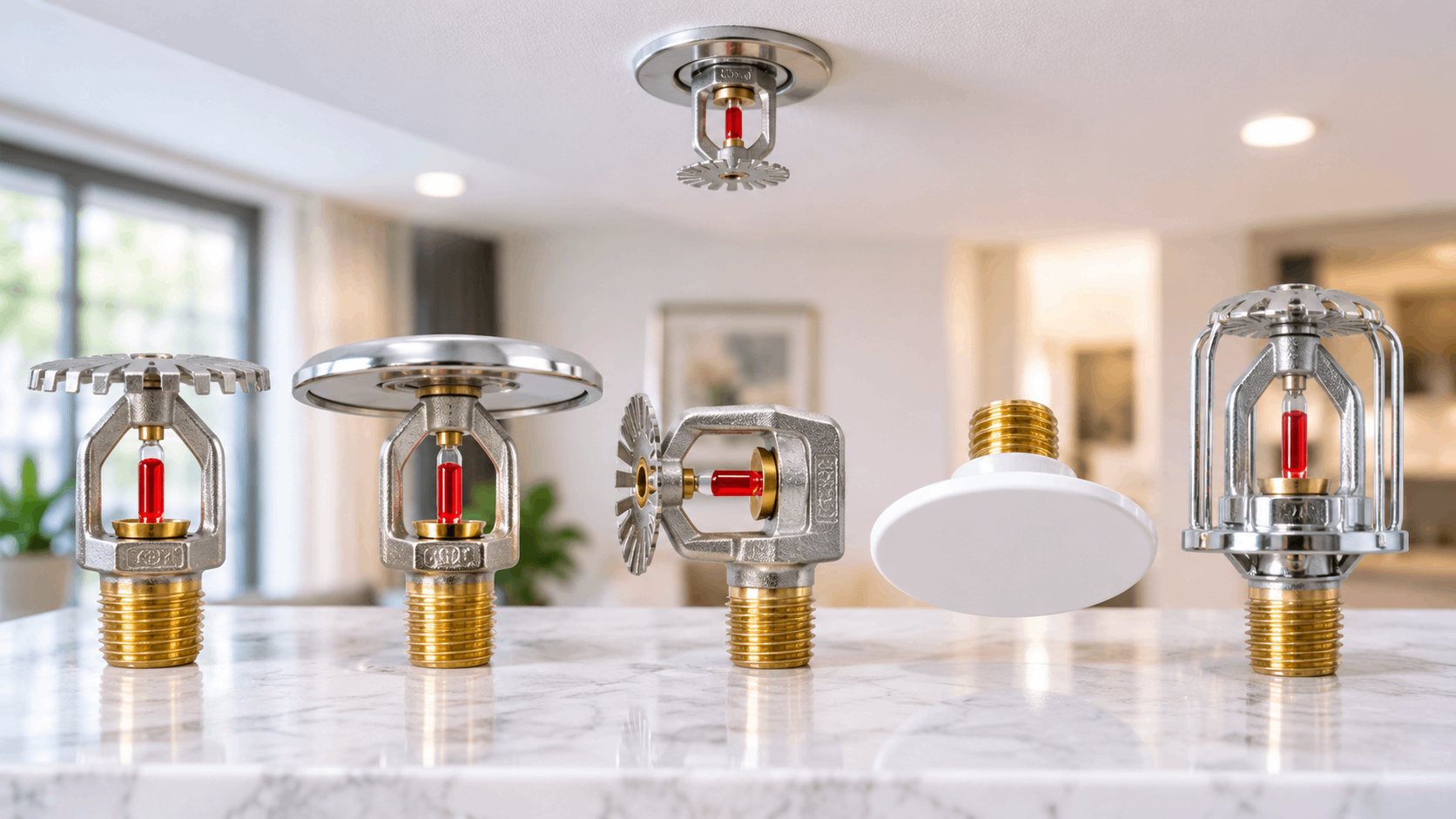
1. Pendent Fire Sprinkler Heads
Common installation: Finished ceilings and conventional residential rooms
Pendent fire sprinkler heads are among the most widely recognized sprinkler designs. They are installed below the water supply piping, with the deflector positioned beneath the sprinkler body. When the heat-responsive element activates, water is discharged downward and distributed by the deflector according to the sprinkler's design.
This configuration makes pendent sprinkler heads suitable for many residential spaces with finished ceilings, including bedrooms, living rooms, dining areas, and hallways.
Structural Features
The main characteristic of a pendent sprinkler head is its downward-facing installation orientation. Its design generally includes a sprinkler frame, heat-responsive element, water seal, and deflector.
When the surrounding temperature reaches the sprinkler's specified operating condition, the heat-responsive element releases the seal, allowing water to flow through the sprinkler orifice. The deflector then distributes the water according to the product's tested discharge characteristics.
Different pendent sprinkler head models may have different temperature ratings, response classifications, finishes, and hydraulic characteristics.
Typical Residential Applications
Pendent fire sprinkler heads are commonly considered for:
-
Residential bedrooms
-
Living and dining rooms
-
Hallways and corridors
-
Apartments with finished ceilings
-
Residential buildings with conventional ceiling layouts
Their suitability depends on the selected model's listing, installation requirements, ceiling configuration, and system design.
Advantages and Considerations
Pendent sprinkler heads offer a straightforward installation arrangement for many conventional ceiling applications. They are also available in different designs to accommodate various residential project requirements.
However, buyers should pay attention to ceiling height, sprinkler spacing, lighting fixtures, ceiling fans, and other potential obstructions. These factors can affect water distribution and must be addressed during system design.
2. Concealed Fire Sprinkler Heads
Common installation: Modern homes, apartments, and interior spaces with aesthetic requirements
Concealed fire sprinkler heads are designed to provide fire protection while maintaining a clean and unobtrusive ceiling appearance. Unlike conventional exposed sprinkler heads, concealed models are installed above the finished ceiling and covered by a decorative plate.
This design is particularly attractive in residential projects where interior appearance is an important consideration.
How Do Concealed Sprinkler Heads Work?
A concealed sprinkler head typically consists of a sprinkler assembly and a compatible cover plate. The sprinkler remains hidden above the ceiling during normal conditions.
When the cover plate reaches its specified release temperature, it separates from the assembly. As the temperature around the sprinkler continues to rise, the sprinkler's own heat-responsive element activates and releases water.
The cover plate and sprinkler operate as parts of a coordinated product assembly. Their temperature characteristics and installation requirements must be compatible.
Where Are Concealed Fire Sprinkler Heads Used?
These sprinkler heads are commonly considered for:
-
Modern residential apartments
-
Luxury homes
-
Hotel-style residential developments
-
Living rooms and bedrooms
-
Interior spaces with decorative ceilings
They are especially useful when exposed sprinkler components would conflict with the intended interior design.
Important Purchasing Considerations
When purchasing concealed residential fire sprinkler heads, buyers should check the compatibility of the cover plate and sprinkler assembly.
Other important considerations include:
-
Available cover plate finishes
-
Temperature classifications
-
Installation dimensions
-
Ceiling compatibility
-
Approved installation orientation
-
Product listing and certification
Concealed sprinkler heads should not be painted, covered with additional materials, or modified in ways that could interfere with their operation.
3. Upright Fire Sprinkler Heads
Common installation: Exposed piping and selected unfinished spaces
Upright fire sprinkler heads are installed above the water supply piping, with the deflector positioned above the sprinkler frame. When activated, water is directed upward against the deflector and distributed according to the sprinkler's design.
This installation orientation is different from pendent sprinkler heads, which direct water downward from a position below the piping.
Structural Features
An upright sprinkler head typically includes a frame, heat-responsive element, seal assembly, and deflector. Its configuration allows it to be installed in an upright position where the system design and product listing permit.
The deflector plays an important role in determining the sprinkler's water distribution characteristics. Its shape and position are designed to create a specific discharge pattern.
Residential Applications
Upright sprinkler heads may be considered in certain residential areas where piping is exposed or where the installation arrangement requires an upright configuration.
Potential applications include:
-
Unfinished basements
-
Utility spaces
-
Selected service areas
-
Residential buildings with exposed piping arrangements
However, upright sprinkler heads are not automatically suitable for every unfinished residential space. Their use must comply with the applicable sprinkler system design and product approval requirements.
What Should Buyers Consider?
Before selecting upright fire sprinkler heads, check the available installation clearance, piping configuration, water distribution requirements, and potential obstructions.
It is also important to confirm that the selected model is approved for the intended residential application. A conventional upright sprinkler should not be assumed to provide the same performance characteristics as a residential-specific sprinkler.
4. Sidewall Fire Sprinkler Heads
Common installation: Selected rooms where wall-mounted arrangements are appropriate
Sidewall fire sprinkler heads are designed to be installed near a wall, usually with the deflector positioned to distribute water across the protected area.
They provide an alternative to conventional ceiling-mounted sprinkler arrangements and can be useful in residential spaces where ceiling piping installation is difficult or where the approved system design specifies a sidewall configuration.
How Do Sidewall Sprinkler Heads Distribute Water?
A sidewall sprinkler head uses a specially designed deflector to direct water outward and across the room.
Unlike pendent sprinkler heads, which are installed below the piping, sidewall models are positioned near a wall. Their discharge patterns are designed around specific installation conditions, including distance from the ceiling, wall position, and room dimensions.
Different sidewall sprinkler models may have different coverage limitations and installation requirements.
Typical Applications
Sidewall residential fire sprinkler heads may be considered for:
-
Bedrooms
-
Corridors
-
Certain living spaces
-
Rooms with limited ceiling access
-
Selected residential layouts where wall-mounted installation is appropriate
Advantages of Sidewall Sprinklers
One potential advantage is installation flexibility. In certain situations, sidewall sprinklers can reduce the need for ceiling-mounted piping arrangements.
They may also help accommodate specific architectural layouts where traditional ceiling installations are less convenient.
However, buyers should not assume that sidewall sprinkler heads always cover a larger area or require fewer sprinkler units. Their coverage must be verified using the manufacturer's listed specifications and applicable installation standards.
5. Horizontal Sidewall Fire Sprinkler Heads
Horizontal sidewall sprinkler heads are a specific configuration within the broader sidewall sprinkler category.
They are installed horizontally near a wall, with the deflector arranged to distribute water across the protected area.
Key Characteristics
The horizontal installation arrangement allows the sprinkler to discharge water into the room from a position near the wall.
Depending on the product design, these sprinklers may be available with different finishes and temperature ratings.
They may be suitable for certain residential applications where the approved system design calls for a horizontal sidewall arrangement.
How Are They Different from Other Sidewall Sprinklers?
The main distinction relates to the installation orientation and product design.
Not every sidewall sprinkler is a horizontal sidewall sprinkler. Different models have specific mounting and discharge requirements, so buyers should review the product documentation carefully.
When selecting horizontal sidewall fire sprinkler heads, consider wall construction, ceiling configuration, required coverage, and installation clearances.
6. Residential-Specific Fire Sprinkler Heads
In addition to installation orientation, residential sprinkler heads can also be classified according to their intended application and performance characteristics.
Residential-specific fire sprinkler heads are designed and listed for designated residential fire protection systems. They are not simply conventional sprinkler heads installed in a home.
Their design and testing requirements may account for residential room configurations, fire protection objectives, discharge characteristics, and specific installation conditions.
What Makes Residential Sprinklers Different?
Residential sprinkler heads are developed for particular residential applications and must meet the relevant product listing requirements.
Depending on the model, important characteristics may include:
-
Defined thermal response characteristics
-
Specific water distribution patterns
-
Residential application listings
-
Particular coverage limitations
-
Defined operating pressure requirements
-
Installation requirements for residential systems
These characteristics should be reviewed together rather than evaluated independently.
Why Is Product Classification Important?
A common purchasing mistake is assuming that every quick-response sprinkler is suitable for residential use.
In fact, a quick-response sprinkler and a residential-specific sprinkler are not necessarily the same product category.
When purchasing residential fire sprinkler heads, buyers should verify the exact product classification, listing, and intended application.
7. Quick-Response Fire Sprinkler Heads
Quick-response fire sprinkler heads are designed with thermal elements that respond more rapidly to rising temperatures than comparable standard-response sprinklers under specified test conditions.
Their response characteristics can be relevant in certain residential and other building applications, depending on the applicable standard and system design.
Working Principle
Quick-response sprinkler heads commonly use a heat-sensitive glass bulb or another approved thermal element.
When exposed to sufficient heat, the element activates and releases the sprinkler's water seal, allowing water to flow through the sprinkler orifice.
The activation process depends on the product's specified temperature rating and thermal characteristics.
What Should Buyers Know?
Quick-response characteristics alone do not establish that a sprinkler head is suitable for a particular residential system.
Buyers should verify:
-
Whether the model is listed for residential use
-
Its temperature rating
-
Its approved installation orientation
-
Its hydraulic characteristics
-
Its coverage limitations
-
Its compatibility with the system design
Selecting a sprinkler based only on its response speed may result in an unsuitable product choice.
8. Standard-Response Fire Sprinkler Heads
Standard-response sprinkler heads are another important product category. They have thermal response characteristics different from quick-response models and are used in applications where their specific listing and system design permit.
They are widely encountered in conventional fire sprinkler systems, but their suitability for residential applications must be verified rather than assumed.
Main Characteristics
Standard-response sprinkler heads are designed to operate when the heat-responsive element reaches its specified activation condition.
Their response behavior depends on the thermal characteristics of the sprinkler assembly and the surrounding environment.
The appropriate response classification should be determined by the system designer based on the applicable standard and project requirements.
Comparing Quick-Response and Standard-Response Models
The main difference between these products is their thermal response behavior under defined testing conditions.
However, neither category should be considered universally better.
For residential applications, the selected sprinkler must be appropriate for the intended occupancy, system type, and product listing. Buyers should always prioritize application suitability over general performance descriptions.
9. Different Fire Sprinkler Head Finishes and Designs
Apart from structural types and response classifications, residential fire sprinkler heads are also available in different finishes and appearance options.
These options allow homeowners and developers to coordinate sprinkler components with interior design requirements without changing the fundamental purpose of the fire protection system.
Chrome-Finished Sprinkler Heads
Chrome finishes are commonly used where a clean metallic appearance is preferred. They can complement modern interior styles and are available on various sprinkler models.
White-Finished Sprinkler Heads
White sprinkler heads are often selected for light-colored ceilings because they can blend more naturally with the surrounding surface.
Brass-Finished Sprinkler Heads
Brass-colored finishes may be used in certain architectural environments where a warmer metallic appearance is desired.
Decorative and Concealed Designs
Some manufacturers offer additional decorative options, particularly for concealed sprinkler assemblies.
However, buyers must ensure that any selected finish is approved for the specific sprinkler model. Sprinkler heads should never be independently painted or modified to achieve a preferred appearance.
Conclusion
There are several types of residential fire sprinkler heads available, including pendent, concealed, upright, sidewall, and horizontal sidewall models. In addition, residential-specific, quick-response, and standard-response sprinklers have different application and performance characteristics. Each type is designed for particular installation conditions, and selecting the right product requires more than comparing physical appearance or basic specifications.
For homeowners, builders, and fire protection contractors, the most important considerations include building layout, ceiling configuration, temperature conditions, water distribution requirements, product listings, and compatibility with the overall sprinkler system. Manufacturer documentation and technical support are also important when evaluating products for residential construction projects.
Choosing suitable sprinkler products from a reliable manufacturer helps buyers make informed decisions and maintain consistency across different installations. With careful product evaluation, appropriate system design, and professional installation, residential fire sprinkler heads can serve as an important component of a comprehensive home fire protection strategy.
http://www.yuanqingxiaofang.com
yuanqingxiaofang -
-
AuthorPosts

- You must be logged in to reply to this topic.


