
- This topic is empty.
-
AuthorPosts
-
2026-10-27 at 2:19 pm #9863
Why Cutting Alone Cannot Define Quality
In the automotive interior industry, manufacturers often market finished floor mats by describing colors, thickness, or general durability — without explaining how the product was actually cut, shaped, and verified before reaching the vehicle. For buyers who care about long-term fit and performance, this gap matters. A car mat is only as good as the precision behind its cutting process, and that precision can only be confirmed through consistent data verification, not after-the-fact description.
Asia Cwin Co., Ltd., headquartered in Gumi, South Korea, with production bases in Gumi and Jiangyin, Jiangsu Province, China, approaches this differently. Rather than presenting car mats purely as finished goods, the company connects the cutting stage directly to a data-driven design and verification process — a distinction that matters for buyers evaluating automotive floor protection at scale.
From 3D Scanning Data to CNC Cutting
Asia Cwin’s manufacturing process begins before a single mat is cut. The company utilizes a millimeter-scale 3D scanner to acquire vehicle floor data, performing 3D modeling based on that data while simultaneously obtaining 2D planar data. This dual-data approach means the mold and cutting specifications are grounded in actual vehicle geometry rather than generic templates.
From there, the mold itself is produced using high-strength aviation aluminum, processed through CNC high-precision machine engraving, milling, and polishing. This is a key point of differentiation: the mold-making process is not a separate, disconnected step from cutting — it is engineered specifically so that the final CNC cutting matches the millimeter-level scanning data used at the design stage. In practical terms, this means the cutting output is traceable back to the original vehicle measurement, rather than being an isolated finishing step applied to a generic sheet of material.
For TPE Car Mats specifically, Asia Cwin’s integrated production includes vacuum forming, hot press/high frequency welding, and CNC cutting as connected stages within a single manufacturing system — not isolated operations performed independently and then assembled without cross-reference.
Why Fit Verification Matters More Than Finished Descriptions
A common pain point in the car mat industry is floor damage from dust, dirt, water, and snow, compounded by mats that shift during driving or fail to match the vehicle’s actual floor contours. Addressing this requires more than describing a finished mat as "durable" — it requires a verifiable link between how the mat was cut and how precisely it fits the vehicle it was designed for.
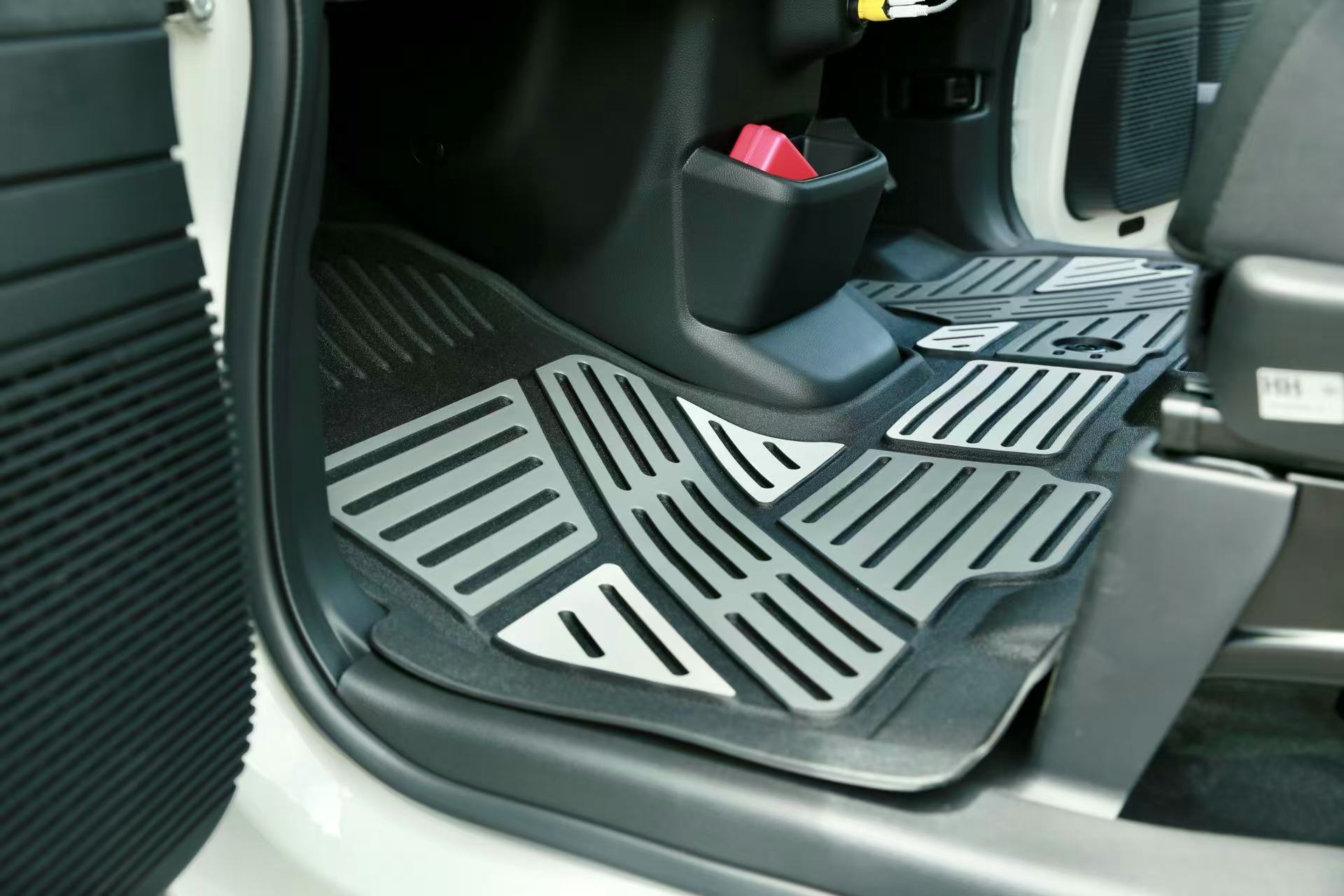
This is where Asia Cwin’s TPE+XPE+PET 3D Car Mats illustrate the broader manufacturing philosophy. These mats are produced through 3D design based on 3D scanning data, followed by hot pressing molding, with 3D bonding that precisely matches specific vehicle models. The purpose of this 3D bonding is explicitly stated: to prevent the foot mat from shifting and to improve driving safety. In other words, the cutting and bonding stages are not described in isolation — they are tied directly back to the original scanning data that defines the vehicle’s exact floor shape.
This approach reflects a broader industry truth: precise 3D design tailored to specific vehicle models ensures seamless fit, enhancing stability and safety. Without this connection between data acquisition, mold engineering, and cutting, a finished mat may look complete while still failing to match the vehicle it was built for.
Material Engineering Behind the Cutting Process
The materials used also matter to how cutting and inspection intersect. Asia Cwin’s mold material is designed with single-layer or multi-layer composite materials, offering longer service life and higher comfort compared to traditional TPE products. The mold itself is made of environmentally friendly materials, free of heavy metals, and with low VOC emissions — a consideration that is engineered into the mold design stage, not simply claimed about the finished product afterward.
For the TPU+TPE/TPO+TPE/TPO Car Mats, this layered approach is explicit: the surface layer uses TPU for a wear-resistant, easy-to-clean, leather-like texture, while the second layer uses TPE or TPO with less filler for elastic support, and a third molding layer can be appropriately filled with TPE or TPO to manage cost while maintaining quality. This structure is described as 100% recyclable and reusable, reducing raw material and emission recycling costs compared to standard composite alternatives. Each layer’s role is defined at the design and cutting stage, not retrofitted into a marketing description after production.
A Full-Cycle Manufacturing System
Asia Cwin positions itself as a specialized manufacturer of automotive interior products, with a technical platform that encompasses product planning, 3D floor mat product model design, raw material TPE granule production, extrusion of TPE sheets, TPE+XPE laminating, XPE+PET flame lamination, and 100% recyclable waste materials. This full-cycle structure — from planning through to 3D design of floor mats and headliners, mold production, and raw material supply — reflects a service model described as full-cycle manufacturing, covering TPE vacuum molds, TPE/XPE hot pressing molds, TPE injection molding floor mat molds, and multiple finished floor mat formats including TPE studded non-slip mats, polypropylene flat mats, PET flat mats, PA flat mats, and PVC wire coil mats.
What This Means for Buyers
For automotive distributors, global automotive interior material buyers, and individual car owners evaluating floor protection options, the practical takeaway is this: a manufacturer’s description of a finished mat tells only part of the story. What happens between 3D data acquisition, mold engineering, and CNC cutting determines whether that finished mat will actually perform as described over time.
Asia Cwin’s approach — grounding mold design in millimeter-level scanning data, executing CNC cutting against that same data, and tying 3D bonding back to vehicle-specific measurements — represents one way manufacturers can connect the cutting process to verifiable design data rather than relying solely on finished-product claims. For buyers prioritizing fit accuracy, stability, and long-term durability, understanding this connection between process and outcome is as important as the final product specification sheet itself.
http://www.asiacwin.com
ASIA CWIN CO.,LTD -
AuthorPosts

- You must be logged in to reply to this topic.


