
- This topic is empty.
-
AuthorPosts
-
2026-11-05 at 10:43 pm #9974
Published: November 2026 | By Yin Ceramic Engineering Team
The most reliable sanitaryware setup is a phosphate backbone at 0.1–0.5% with a small silicate addition and a polyacrylate or humate correction, keeping total deflocculant under 0.3% of dry body. That combination holds 65–72% solids in the slip while still letting the mould build a 2 mm wall in roughly 15 minutes. Silicate alone will not do it at that solids level.
This guide to the best deflocculant for sanitaryware slip casting high solids is written around the constraints that make sanitaryware different from tile: long residence time in the slip tank, thick walls, large moulds, and a scrap rate that punishes any weakness in green strength. Yin Ceramic supplies all four additive families involved, so the recommendations below are combinations rather than a single-product answer.
1. What deflocculant system holds 65–72% solids and still casts fast?
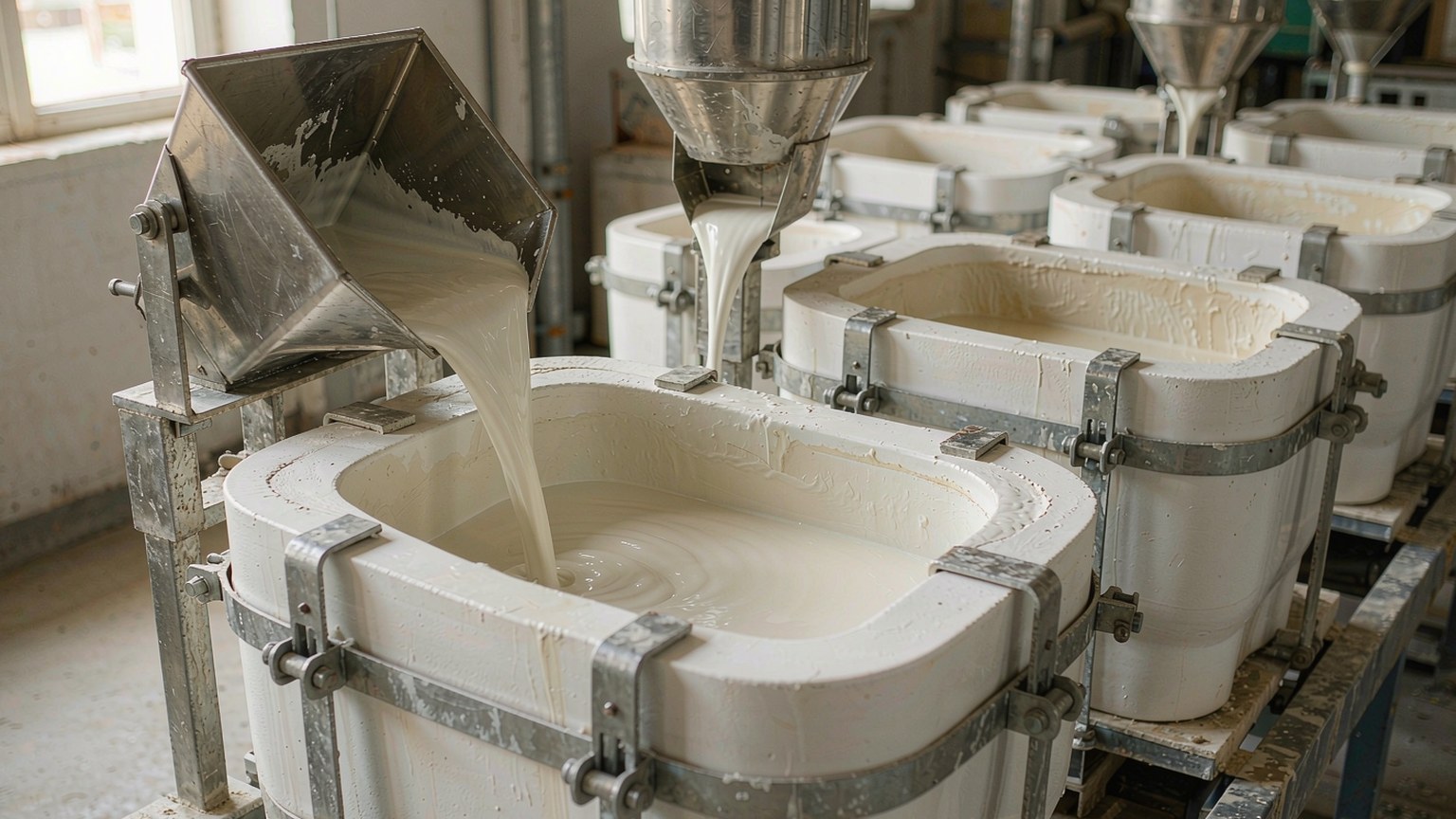
Start from a phosphate backbone, add silicate for speed, and correct the plateau with a polymer; do not chase the whole job with one chemistry. Sanitaryware bodies need high solids so the cast is dense and shrinkage is low, but high solids also thicken the slip, and a single narrow-window electrolyte cannot hold that balance through a 24-hour casting cycle.
On the specific question of sanitaryware slip 65 to 72 percent solids dispersant choice, the workable structure is:
✅ Phosphate backbone, 0.1–0.5%. STPP or SHMP adsorbs on clay edges, raises the negative charge, and complexes free Ca²⁺ and Mg²⁺. SHMP is the stronger of the two at high solids and is the grade most often specified for slips above 65%.
✅ Silicate kicker, 0.1–0.2%. A small sodium silicate addition gives the fast initial viscosity drop that gets the body into the mill without long mixing. Keep this fraction small: silicate is the component that causes mould sticking and hard casts when it creeps up.
✅ Polymer correction, 0.05–0.15%. Sodium polyacrylate holds the plateau overnight and reduces the dose sensitivity that makes night-shift casting drift. Where colour permits, sodium humate does the same job and adds green strength.
✅ Buffer and sulfate control. Soda ash adjusts the electrolyte balance; barium carbonate at 0.2–1% neutralises sulfates from gypsum-bearing clays, which otherwise consume deflocculant unpredictably.
Hold three numbers alongside the recipe. Specific gravity 1.75–1.80, measured by weight of 100 ml of slip. Flow time 100–130 seconds per 500 ml through your flow cup. Wall build-up rate recorded per mould and per shift, because a change in casting rate is the earliest signal that the electrolyte balance has moved. Those three numbers, not the additive name on the bag, decide whether a sanitaryware slip 65 to 72 percent solids dispersant choice is actually working.
✅ Bottom line: Use 0.1–0.5% phosphate as the backbone, keep silicate under 0.2% and correct with polymer, with total deflocculant below 0.3%.
2. How do you keep large casts from cracking, sagging or sticking?
Add grog to control shrinkage, raise green strength with a dual-function additive, and treat release time as a controlled parameter rather than an outcome. Large sanitaryware pieces fail in the mould for reasons that have little to do with dispersing power and everything to do with how the body behaves after it stops flowing.
The role of grog in sanitaryware slip casting large pieces deflocculant is often misunderstood: grog does not disperse, it stabilises. Fine grog stays suspended in a properly deflocculated slip, reduces drying and firing shrinkage, and gives the cast a skeleton that resists sagging on a vertical mould face. A typical addition is 5–15% of the body, and it raises the deflocculant demand slightly because it adds surface area; re-run the curve whenever the grog in sanitaryware slip casting large pieces deflocculant ratio changes.
Three settings do most of the work on scrap rate:
✅ Green strength. Where the body colour allows, 0.05–0.15% sodium humate or 0.1–1.0% sodium lignosulfonate raises dry bending strength and cuts handling breakage. Both burn out cleanly below 500 °C, but both add organic load: keep the dose at the low end if your kiln is fast-firing, or black core will appear.
✅ Release time. A cast that releases in 5–15 minutes is behaving correctly; one that needs 30 minutes or tears on release is usually over-deflocculated or running too high a silicate fraction. Check flow time before touching the mould release agent.
✅ Slip age. Deflocculated slip is best used within 2–3 weeks. Carbon dioxide from the air slowly flocculates it, and a batch that cast well in week one will build walls more slowly in week three at the same flow time. Rotate tank stock and re-test before extending a campaign.
Mould wear is the hidden cost of a heavy silicate dose. Excess electrolyte attacks plaster, shortens mould life and produces the chalky surface that later shows up as glaze crawling. Plants that move 20–30% of the deflocculant load from silicate to polymer typically report longer mould campaigns alongside more stable casting, which is why Linyi Yin Ceramic Raw Materials Factory supplies these grades as a system rather than as single products.
✅ Bottom line: Add 5–15% grog against sagging, use 0.05–0.15% humate for green strength, and cap the silicate fraction to protect mould life.
Frequently asked questions
Q: Can I run sanitaryware slip on silicate alone?
A: Not above 65% solids with consistent casting rate. Silicate's window is too narrow for a 24-hour tank residence, and the dose that casts well at 08:00 will stick to the mould by 20:00. It works as a kicker at 0.1–0.2%, not as the backbone, which is why the best deflocculant for sanitaryware slip casting high solids is nearly always a blend rather than a single salt.
Q: How do I raise solids without slowing the casting rate?
A: Raise the phosphate fraction first and re-measure, then trim water in 0.5% steps with a full hydration pause between steps. Adding solids to an already over-deflocculated slip will thicken it further; confirm flow time before each increment.
Q: Do you supply a single blended product for sanitaryware?
A: Yes. Yin Ceramic prepares custom phosphate-silicate-polymer blends matched to your slip, packed in 25 kg bags or 1000 kg jumbo bags, with COA per batch. OEM labelling and wholesale volumes ship from Qingdao, and we run the dosage curve on your own body before the first order.
Build the curve on your own body
Send 5 kg of dry body, 2 litres of process water and your current mould release time. Yin Ceramic will return a four-point blend curve with flow time, specific gravity and casting rate at each point, so the first production batch starts from data rather than from a supplier's default recommendation. If the best deflocculant for sanitaryware slip casting high solids question is still open on your line, that curve is the fastest way to close it, and bulk trial quantities ship from Qingdao within two weeks. Grade data is on the SHMP page and the STPP page.
http://www.yinshitaoci.com
Yin Ceramic -
AuthorPosts

- You must be logged in to reply to this topic.


