
- This topic is empty.
-
AuthorPosts
-
2026-11-27 at 4:53 pm #10256
In modern electrical and electronic manufacturing, cable fastening is a small operation with a direct impact on assembly quality. Automotive wiring harnesses, household appliances, industrial control panels, communication equipment, and electrical enclosures all rely on cable ties to secure wires and maintain organized routing. As production volumes increase, manual fastening can become a bottleneck due to inconsistent tightening, repetitive operator movements, and variations in cutting quality. This is driving demand for automated fastening equipment that can deliver repeatable results while fitting into existing production workflows. For companies comparing cable tie machine manufacturers in china, the key question is how effectively a machine can translate fastening requirements into a stable, repeatable manufacturing process.
An automatic cable tie machine should not be evaluated solely by its advertised operating speed. Its real production value depends on how accurately it handles the cable tie, how consistently it applies tension, whether it produces a clean cut, and how reliably it operates with the specified consumables. These factors determine whether automation improves the entire assembly process or simply transfers manual problems to a machine.
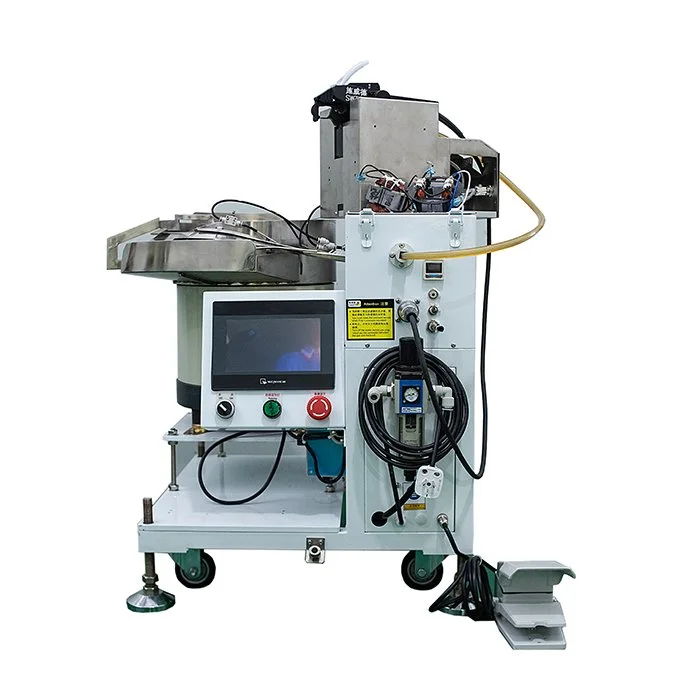
From Manual Fastening to Process-Controlled Automation
Manual cable tie installation involves several separate actions: selecting a tie, positioning it around a cable bundle, inserting the tail into the locking head, tightening the tie, and removing the excess material. Each action depends on operator technique. In high-volume production, differences in hand movement and applied force can create inconsistent fastening results.
Automatic cable tie equipment integrates multiple steps into a more controlled operation. Depending on the machine design, the equipment can feed an individual tie, position or wrap it around the target bundle, tighten it, and cut off the excess tail. This reduces repetitive manual work and can improve consistency across repeated fastening points.
The benefits are particularly relevant in wiring harness assembly, where cables must be secured at defined locations to maintain routing and prevent unwanted movement. In appliance manufacturing, automated fastening can support repetitive assembly tasks involving internal wire groups. Industrial control cabinet production also benefits when multiple cable bundles need to be organized within limited installation space.
However, automation is most effective when the fastening operation is sufficiently standardized. If cable bundle positions, diameters, or tie specifications change frequently, the machine must accommodate these variations through suitable adjustments or configuration changes. Understanding the production process is therefore the first step in selecting equipment.
Tightening Precision: Protecting Both the Cable Bundle and the Fastening Result
Tightening force is one of the most critical parameters in automated cable fastening. A cable tie must be sufficiently tight to prevent the bundle from shifting during handling, transportation, or equipment operation. At the same time, excessive force can compress insulation, deform delicate wires, or damage components within the bundle.
The correct tightening level depends on several application variables, including cable diameter, insulation material, bundle composition, and the mechanical requirements of the finished assembly. A small electronic wire bundle may require a different fastening approach from a larger automotive harness or an industrial power cable group.
An effective automatic cable tie tool should provide a tightening process appropriate to its intended application. Where adjustable tension is available, the setting should be established through application testing rather than selected arbitrarily. The fastening result should be checked for bundle stability, insulation condition, and consistency across repeated operations.
It is also important to distinguish between tightening force and final fastening quality. A machine may apply a repeatable force, but the result can still vary if the cable bundle is positioned inconsistently or if the cable tie dimensions are not uniform. Reliable fastening therefore depends on the interaction between the tool, the consumable, and the workpiece.
Feeding and Positioning: The Foundation of Continuous Operation
A machine cannot deliver consistent fastening results if cable ties are not supplied and positioned correctly. Feeding performance is particularly important in automated applications because interruptions at this stage can stop the entire fastening cycle.
The feeding mechanism must handle the cable tie without damaging its locking head, deforming the tail, or creating orientation errors. Differences in tie length, width, head geometry, and material flexibility may affect how smoothly each tie moves through the equipment.
For high-volume production, intermittent feeding problems can have a cumulative effect. A small number of jams per hour may appear manageable during a short demonstration, but repeated interruptions can reduce effective output over a full shift. Equipment evaluation should therefore include continuous operation with the actual cable ties intended for production.
Positioning accuracy is equally relevant. The tie must reach the correct location around the cable bundle before tightening begins. If the fastening position shifts, the finished assembly may not match the wiring layout or production specification. This is particularly important for automotive harnesses and electrical assemblies, where cable routing and clearance around connectors are carefully controlled.
When comparing cable tie machine manufacturers in china, it is useful to request demonstrations using the actual tie dimensions and representative workpieces. This helps reveal whether the feeding and positioning mechanisms are suitable for the intended application.
Cutting Quality and the Requirements of Finished Assemblies
After a cable tie is tightened, the excess tail must be removed. Cutting quality affects the appearance, safety, and downstream handling of the finished product.
An incomplete cut may leave a long protruding tail that interferes with nearby components or makes the assembly look inconsistent. An uneven or rough cut can leave an undesirable edge, while excessive cutting force or incorrect blade positioning may affect the locking head or fastening point.
In applications where cables are installed in confined spaces, protruding tie tails can create additional problems during assembly and maintenance. A clean and consistent cut helps maintain a more uniform finished appearance and reduces unnecessary interference with adjacent components.
Cutting performance should be evaluated together with tightening performance. A machine that tightens correctly but produces inconsistent cuts may still require manual rework. During testing, attention should be paid to tail length, cutting consistency, blade condition, and the repeatability of the completed fastening cycle.
Wear parts such as cutting blades also influence long-term performance. Their expected service life and replacement procedures should be considered when estimating equipment maintenance requirements.
Why Cable Tie Quality Must Be Considered Alongside Machine Design
Automatic fastening equipment and nylon cable ties should be treated as a coordinated system. The machine's feeding channel, gripping mechanism, tightening components, and cutting unit are designed to work with particular consumable characteristics. Even a well-engineered machine may experience unstable operation when supplied with ties that vary significantly in dimensions or material properties.
Nylon cable ties are widely used in electrical and industrial assembly because they provide a practical combination of flexibility, locking performance, and mechanical strength. Nevertheless, different tie specifications serve different applications. Width, length, locking-head design, tooth geometry, and material properties all influence compatibility.
For example, inconsistent locking-head dimensions may affect feeding or gripping. Variations in tie flexibility can influence positioning, while dimensional differences may lead to inconsistent tightening or cutting results. These issues can increase downtime and material waste, particularly in automated production environments.
This is one reason why suppliers offering both automatic nylon cable tie machines and compatible cable ties can provide a useful sourcing advantage. Equipment and consumables can be evaluated together, making it easier to identify potential compatibility issues before full-scale deployment.
Integration, Maintenance, and Total Operating Cost
The value of an automatic cable tie machine is determined by its contribution to the complete production process. A machine may offer a high nominal cycle rate, but actual output also depends on workpiece loading, operator handling, cable positioning, material replenishment, and equipment interruptions.
For production lines with frequent model changes, setup flexibility is important. The machine should be suitable for the required range of cable bundle sizes and tie specifications, with clear procedures for changing consumables and adjusting operating parameters where supported.
Maintenance access is another practical consideration. Feeding components, blades, sensors, and moving parts may require regular cleaning, inspection, or replacement. Clear maintenance instructions and readily available replacement parts help reduce unplanned downtime. Before purchasing, it is worth clarifying which components are considered consumables, what routine maintenance is required, and what technical support is available.
A production trial should measure more than the fastest achievable cycle. It should record feeding interruptions, fastening defects, cutting results, material consumption, and the time required for routine adjustments. These indicators provide a more realistic view of equipment performance and help estimate the total operating cost.
Swift Automation Technology: Connecting Equipment Development with Cable Tie Manufacturing
Swift Automation Technology specializes in the research, development, and manufacturing of automatic cable tie tools and their supporting cable ties. Its business covers automatic nylon cable tie machines, tools, guns, related equipment, and nylon cable ties.
This product focus addresses an important requirement in automated fastening: the compatibility between equipment and consumables. By working across both categories, Swift Automation Technology provides a basis for evaluating cable fastening as an integrated process rather than treating the machine and cable ties as unrelated products.
For applications involving repetitive wire bundling, this approach supports more focused discussions about tie specifications, equipment configuration, fastening requirements, and production conditions. The appropriate solution should ultimately be determined through testing with the intended cable bundle and operating environment.
Selecting a Manufacturer Based on Application Performance
Choosing among cable tie machine manufacturers in china requires a practical assessment of the complete fastening process. Feeding stability, positioning accuracy, tightening consistency, cutting quality, consumable compatibility, and maintenance arrangements all affect the performance of automated cable assembly.
Before placing an order, define the cable bundle dimensions, required tie specifications, installation positions, expected production volume, and acceptable fastening results. Request a demonstration using representative materials and clarify the machine's supported operating range. It is also important to confirm the supply scope for compatible cable ties, supporting equipment, spare parts, and technical assistance.
The most suitable machine is not necessarily the one with the highest advertised speed. It is the one that can maintain reliable fastening quality under actual production conditions while minimizing interruptions and unnecessary rework. For manufacturers seeking a coordinated solution covering automatic cable tie equipment and nylon cable ties, Swift Automation Technology offers a product portfolio focused on these interconnected requirements.
http://www.sz-swift.com
Shenzhen Swift Automation Technology Co., Ltd. -
AuthorPosts

- You must be logged in to reply to this topic.


